After a long delay, I am finally writing about this album...
To understand and to appreciate Stuff Like That There fully, you have to connect it to Yo La Tengo's Fakebook, from 25 years ago. They even have said this is the 25 year anniversary follow-up to it.
I fell in love with Facebook, 18 years ago, when I picked up a copy while out with one friends before taking a quick road trip to San Diego. I convinced Nick and Mark to let me play Facebook, the entire ride that night. I don't think they got the album the way I got it. I was immediately hooked by the pedal steel, the countrified-folk-indie. The vibe. It set me out on a quest to find the original versions of all this fabulous covers. Over the years, Fakebook, remained one of my own personal cult-classic-ish albums.
To learn that Yo La Tengo were recording a follow-up of sorts? I was all in. Immediately.
Stuff Like That There is a nice, warm, comforting album. It's an album that I can cuddle with in a warm cabin somewhere. It's almost entirely acoustic. It sound the way watercolor landscapes look. It is nostalgia inducing. It is conversation starting. Or, even better, when conversation goes quiet, this album stands in and saves all from the silence.
One definite conversation starter is their version of The Cure's "Friday I'm in Love." So unexpected! So happy to hear this! It's exactly what a cover should be--paying respect to a song you admire by not recording an identical version. But instead to take the song, and reinterpret it to fit your own steez. Your own vibe.
Perhaps that's what is best about Facebook and Stuff Like That There. These are covers. But they are Yo La Tengo songs still. Even the Yo La Tengo originals are reinterpreted. But they are STILL Yo La Tengo songs. A prime example is the rethinking and reworking of their classic track "The Ballad of Red Buckets." It does the original from the album Electr-o-pura justice. And it fits into Stuff Like That There so well, it's almost like it it could not exist anywhere else.
One last piece of beauty I would like to mention here: Hank Williams' "I'm so Lonesome I Could Cry." Georgia's gentle delivery and her interesting pace of delivery bring a new sentiment to this song entirely. There's a feeling of resignation now rather than yearning. Reverb rich guitar lines add color to this art piece.
This album would be paired perfectly with a mug of hot chocolate.
When I lived alone
I sometimes had solitary painting parties on sporadic Saturday nights. I turned
off the cell phone to the outside world, bought a bottle of cheap red wine,
because I really did not know anything about wine back then, and shut myself
in. My only table covered in newspaper became the easel and I surrounded my
blank canvas with distressed brushes, and squeezed and contorted tubes of oil
paint. I grabbed a photograph out of a shoebox or an old album and it became my
spontaneous motif. The cork removed from the wine, to be poured into a white
coffee mug, because I did not have wine glasses back then, and the brush dipped
into the paint mixed on the newspaper to be spread across the canvas in manic,
rapid strokes. A CD from my collection put in the stereo, the volume turned up
just loud enough to be too loud, and when it was finished the next one up would
take its place, the music no doubt influencing the pace and movement of my
painting. A slow album urged me to use more blues, more yellows, pale green
things, and longer softer lines. A fast album coerced reds, bright oranges, and
distant purples, in jagged marks. The music also compelled me to dance alone,
save for the ghost of inspiration, taking silly breaks, to mix some new colors
and get a different perspective on the piece in motion. No matter what, I could
not stand to work on a painting for more than one night, so by the time the
wine was gone, so was my inspiration. The finished painting then had two
possible destinations: 1. If someone liked it then they could take it. 2. If no
one asked for it I hung it up on my apartment walls. Most paintings ended up on
my apartment walls.
Vincent
Van Gogh hung his paintings on his bedroom walls. Van Gogh painted his bedroom
in the French town of Arles three times. In the painting the bedroom walls are a pale blue. A blue
drained of its vigor. The strokes seem to slide down the walls like drops of
rain down a window on a lonely, rainy, Saturday spent indoors. Like tears. This
painting lacks the shining yellows, beating reds, and swirling strokes of his
other paintings from his time in Arles (Think The Starry Night or The Night
Café). The warped wooden bedroom floor, green in the grooves, stretches out
at an uncomfortable decline. It creates an uneasy slant, seeming to empty the
contents of the room out at the viewer. The sparse wooden furniture is mangled
in an invented perspective, evidenced in the footboard of the plain bed
dwarfing the headboard behind. Hanging from the walls are five of Van Gogh’s
own paintings.
The
scene is the bedroom, the most intimate of rooms, of a troubled artist at one
of his most troubled times. He paints his bedroom as a scene of calm and rest,
belying what was taking place outside of the room, and inside of his mind. The
mad Dutchman. Fleeing a period of alcohol sickness, Van Gogh moved to this
“Yellow House” in Arles. He was described by a young girl who sold him colored
pencils as “dirty, badly dressed, and disagreeable… very ugly, ungracious,
impolite, sick.” At Van Gogh’s request, in an attempt to create a utopian
artist commune, Paul Gauguin came to stay with him in the Yellow House. Instead
of utopia, a decomposed friendship turned into arguments and competition, and
with the quarrels, the threats of violence, the infamous razor blade appeared.
Just a few months after he painted Bedroom
at Arles, amidst all of the turmoil with Gauguin, Van Gogh sought the
solace of a prostitute named Rachel, and sliced off pieces of his left ear,
wrapped them in a towel and handed the macabre package to her. Gauguin later
found him at home, unconscious, his red head now crimson, blood saturating the
pillow. Two months later, Van Gogh would be in an asylum. Gauguin never saw his
friend again. A year later, Van Gogh died of an apparent self-inflicted gunshot
wound to the chest. No gun was ever found. Only questions are left.
Like when one of
my painting sessions was interrupted by something I saw printed in the section
of an LA Weekly covering my table from the turpentine that often spilled. According
to the too brief article, Elliott Smith, a singer-songwriter, who I had been a
fan of since high school, and had seen perform live several times, was dead of
an apparent suicide on October 21, 2003. Two stab wounds, self-inflicted in the
chest. In the months following, more details about the suicide were reported.
That he and his girlfriend were arguing in their Echo Park home. She locked
herself in the bathroom to take a shower, heard a scream, opened the door and
found Smith standing, the knife lodged in his chest. He died later in the
hospital. A possible suicide note was found in the home later. It read, “I’m
sorry – love, Elliott. God forgive me.” The official autopsy left open the
possibility of homicide. Only questions are left.
Ruminating back to
my discovery that night still causes me to quaver. I cannot remember if I
actually finished a painting that night. The thought of the self-directed
violence is horrific. Alarming, tragic. His songs were always wrought with
sadness and melancholy, of allusions to abuse and addiction. Back then everyone
who cared about Elliott Smith drove out to the spot on Sunset Boulevard where
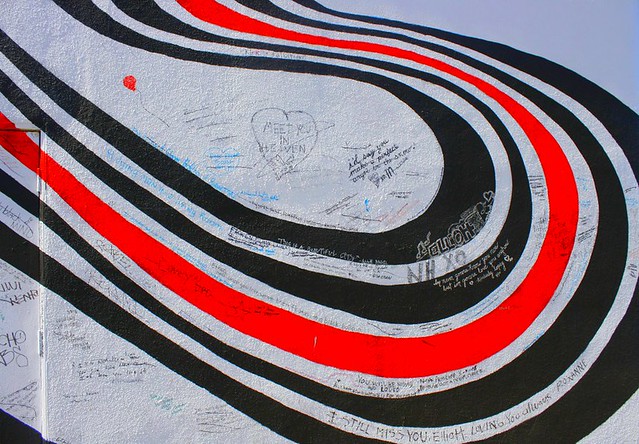
the cover of Smith’s last album Figure 8
was shot. The wall, a mural of swirling blue and red color bars, was
transformed into a memorial to Smith. Standing in front of it made me tremble,
slightly. Just like how I trembled when I saw Bedroom at Arles in person at the Musee d’Orsay in Paris when I was
19. Standing in front of the painting of the room where Van Gogh lived when he
had his major breakdown was disconcerting. That in a matter of weeks, his
mental state will have deteriorated to the point where he will mutilate
himself, before taking the last final step of self-destruction the following
year. And this was his bedroom. Pale blue bars of color stretching down to the
floor. Those paintings of his hanging on the wall. Every morning he would awake
and look up at these paintings above him, the ones he and his brother Theo, the
art dealer, could not find buyers for. They are further proof that the whole
world is concert against him in its rejection.
I never took the
rejection of my paintings seriously at all. Painting was just a hobby, not my
essence of being. I feel a bit bashful when I look at the paintings that I
still have, now living deep in a closet. I feel sad when I see Van Gogh’s Bedroom at Arles. It’s the same feeling
I get when I listen to Elliott Smith’s songs now. In their beauty lies that
deep melancholy. It is heart-breaking to me when such artistic, creative people
capable of producing beautiful gifts to us just cannot convince themselves that
they can fit into this world.