Tuesday, July 16, 2013

Color Bars


When I lived alone I sometimes had solitary painting parties on sporadic Saturday nights. I turned off the cell phone to the outside world, bought a bottle of cheap red wine, because I really did not know anything about wine back then, and shut myself in. My only table covered in newspaper became the easel and I surrounded my blank canvas with distressed brushes, and squeezed and contorted tubes of oil paint. I grabbed a photograph out of a shoebox or an old album and it became my spontaneous motif. The cork removed from the wine, to be poured into a white coffee mug, because I did not have wine glasses back then, and the brush dipped into the paint mixed on the newspaper to be spread across the canvas in manic, rapid strokes. A CD from my collection put in the stereo, the volume turned up just loud enough to be too loud, and when it was finished the next one up would take its place, the music no doubt influencing the pace and movement of my painting. A slow album urged me to use more blues, more yellows, pale green things, and longer softer lines. A fast album coerced reds, bright oranges, and distant purples, in jagged marks. The music also compelled me to dance alone, save for the ghost of inspiration, taking silly breaks, to mix some new colors and get a different perspective on the piece in motion. No matter what, I could not stand to work on a painting for more than one night, so by the time the wine was gone, so was my inspiration. The finished painting then had two possible destinations: 1. If someone liked it then they could take it. 2. If no one asked for it I hung it up on my apartment walls. Most paintings ended up on my apartment walls.
           
      
Vincent Van Gogh hung his paintings on his bedroom walls. Van Gogh painted his bedroom in the French town of Arles three times. In the painting the bedroom walls are a pale blue. A blue drained of its vigor. The strokes seem to slide down the walls like drops of rain down a window on a lonely, rainy, Saturday spent indoors. Like tears. This painting lacks the shining yellows, beating reds, and swirling strokes of his other paintings from his time in Arles (Think The Starry Night or The Night CafĂ©). The warped wooden bedroom floor, green in the grooves, stretches out at an uncomfortable decline. It creates an uneasy slant, seeming to empty the contents of the room out at the viewer. The sparse wooden furniture is mangled in an invented perspective, evidenced in the footboard of the plain bed dwarfing the headboard behind. Hanging from the walls are five of Van Gogh’s own paintings.
           
 The scene is the bedroom, the most intimate of rooms, of a troubled artist at one of his most troubled times. He paints his bedroom as a scene of calm and rest, belying what was taking place outside of the room, and inside of his mind. The mad Dutchman. Fleeing a period of alcohol sickness, Van Gogh moved to this “Yellow House” in Arles. He was described by a young girl who sold him colored pencils as “dirty, badly dressed, and disagreeable… very ugly, ungracious, impolite, sick.” At Van Gogh’s request, in an attempt to create a utopian artist commune, Paul Gauguin came to stay with him in the Yellow House. Instead of utopia, a decomposed friendship turned into arguments and competition, and with the quarrels, the threats of violence, the infamous razor blade appeared. Just a few months after he painted Bedroom at Arles, amidst all of the turmoil with Gauguin, Van Gogh sought the solace of a prostitute named Rachel, and sliced off pieces of his left ear, wrapped them in a towel and handed the macabre package to her. Gauguin later found him at home, unconscious, his red head now crimson, blood saturating the pillow. Two months later, Van Gogh would be in an asylum. Gauguin never saw his friend again. A year later, Van Gogh died of an apparent self-inflicted gunshot wound to the chest. No gun was ever found. Only questions are left.

Like when one of my painting sessions was interrupted by something I saw printed in the section of an LA Weekly covering my table from the turpentine that often spilled. According to the too brief article, Elliott Smith, a singer-songwriter, who I had been a fan of since high school, and had seen perform live several times, was dead of an apparent suicide on October 21, 2003. Two stab wounds, self-inflicted in the chest. In the months following, more details about the suicide were reported. That he and his girlfriend were arguing in their Echo Park home. She locked herself in the bathroom to take a shower, heard a scream, opened the door and found Smith standing, the knife lodged in his chest. He died later in the hospital. A possible suicide note was found in the home later. It read, “I’m sorry – love, Elliott. God forgive me.” The official autopsy left open the possibility of homicide. Only questions are left.  

Ruminating back to my discovery that night still causes me to quaver. I cannot remember if I actually finished a painting that night. The thought of the self-directed violence is horrific. Alarming, tragic. His songs were always wrought with sadness and melancholy, of allusions to abuse and addiction. Back then everyone who cared about Elliott Smith drove out to the spot on Sunset Boulevard where the cover of Smith’s last album Figure 8 was shot. The wall, a mural of swirling blue and red color bars, was transformed into a memorial to Smith. Standing in front of it made me tremble, slightly. Just like how I trembled when I saw Bedroom at Arles in person at the Musee d’Orsay in Paris when I was 19. Standing in front of the painting of the room where Van Gogh lived when he had his major breakdown was disconcerting. That in a matter of weeks, his mental state will have deteriorated to the point where he will mutilate himself, before taking the last final step of self-destruction the following year. And this was his bedroom. Pale blue bars of color stretching down to the floor. Those paintings of his hanging on the wall. Every morning he would awake and look up at these paintings above him, the ones he and his brother Theo, the art dealer, could not find buyers for. They are further proof that the whole world is concert against him in its rejection.

I never took the rejection of my paintings seriously at all. Painting was just a hobby, not my essence of being. I feel a bit bashful when I look at the paintings that I still have, now living deep in a closet. I feel sad when I see Van Gogh’s Bedroom at Arles. It’s the same feeling I get when I listen to Elliott Smith’s songs now. In their beauty lies that deep melancholy. It is heart-breaking to me when such artistic, creative people capable of producing beautiful gifts to us just cannot convince themselves that they can fit into this world.     

Monday, July 8, 2013

Lookin' Out My Back Door


Two months ago, my pregnant wife and I moved over the hill to the San Fernando Valley. For the ten years prior, we lived in apartments, five of those years together in West Los Angeles. But similar to my wife’s belly, we both knew we had to expand. Moving to the valley was not the ideal plan. It took the perfect house to rent to lure us away from the Westside, where my wife had lived her entire life. Where we could not find or afford the place that would be right for us. Maybe one with a walk-in closet for her. A spacious kitchen for me. One with a backyard. After existing in apartments for a decade, I had almost forgotten how glorious one could be.
            Let me tell you about my backyard.
It is shaded by an immense, majestic, and messy mimosa tree, whose long, sweeping branches outstretch like the tentacles of Verne’s octopus, sheltering the grass below, feeding hummingbirds, and releasing 600 flowers a day onto ground. To its right rests an old wooden picnic table, blue at one point, presently faded like beach wood. Now on the supreme teacher perk (a necessity not understood by those outside of education), the summer vacation, I have delighted in the simple bliss of eating breakfast and sipping coffee out at the table. Lining the south side of the yard are many mature fruit trees, planted years ago by the owners. Tangerines, oranges, peaches, plums, pears, apples, lemons, cherries, grapefruit – it is an amazing thing to stroll up to a tree, grab a piece of fruit, and like Eve in that garden, minus the whole being expelled from paradise part, take a bite. Along the eastern edge is a built-in child’s pool. Only two feet deep, but together with a lounge chair and a good book, it is the perfect way to waste a few hours of a summer weekday while the rest of the world is away working. My first attempt at a vegetable and herb garden resides in the northern part of the yard. Its opening day roster includes heirloom tomatoes, bell peppers, cucumbers, broccoli rabe, basil, parsley, and cilantro. My wife said, and is right of course, that I planted too much too close together. We shall see what happens.
As marvelous as all this is, the real wonder that consumes me is my future in this backyard, with my son who is set to make his grand entrance into this world in September. As I am slowly drinking my morning coffee, I gaze across the yard following the swooping paths of birds at play, the racing of squirrels fighting for the fallen fruit, and I can see myself throwing a baseball to, or kicking a soccer ball with, or just chasing around, this vision of who my son could be. I can't picture what he will look like, although he does already have a name, but I do envision this area to be the happy place of him at play, and for me to see the wonderment of life, and its simple pleasures, through the eyes of a child again. And in my head I am singing that Creedence Clearwater Revival song about a fantastic circus at play around John Fogerty’s son as he watches him dance around backyard. And all is right.
I reminisce back to my earliest childhood backyard memories. They begin out in New York, on Long Island. A backyard full of green and trees, family and barbecues, lightning bugs and cicadas, the above-ground pool and the swing-set, and more room than any kid would need to play with his Dad. Somehow, though, we used up every square foot of that land. Me, my dad, my mom, my little brother. Then to the next stage of childhood, when ages turn to double-digits, my family moved out to Temecula, California. The Inland Empire, supposedly. Our house, like every one around it, stood far too close to the next, and its backyard could not compare to the one on Long Island. It began as dirt with a small concrete patio, and remained that way until long after my parents divorced. Quiet. Disregarded. Unlike the Long Island house, when it was time to move, we did not do this together, as a family. First my dad left. Then I moved to Los Angeles. Then my brother got his girlfriend pregnant. Later, my mom and sister finally left, as well.
Until now, that was the last backyard I could call, in any capacity, mine. I had left Temecula and moved to Redondo Beach, where backyards are a luxury. But throughout my twenties, a backyard never registered that high on my list of priorities. I even thought at one point that I would live out my life in an apartment just like Jerry on the show Seinfeld. Finally it set in, really much later than it should have, that it’s not me who will be that that kid running around in this grass chasing butterflies. I am going to be Dad now. I stand out in my backyard, with my arms around my wife and her belly, the next world waiting in her womb, as she enjoyed a popsicle straight from the ice cream man, and I know that a backyard is for family. 

Thursday, June 13, 2013

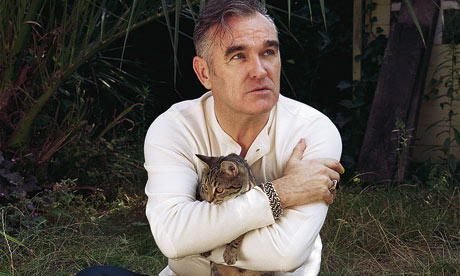
"My Lovelife" Morrissey

I grew up believing that only priests could (or would want to) be celibate. The church child-abuse scandals of the past decades have shown I was oh so wrong about that. But back to my naive younger days. I was all of fourteen years old when I saw an MTV News clip about a British singer saying that he was celibate. That he would rather go to bed with a good book than with a good... well, you know. This Morrissey. Is he for real? He's a rockstar. He doesn't want to get laid? Come on now. My fourteen year old mind just could not comprehend that someone who had the opportunity to see breasts would ever turn down the opportunity to see breasts. Morrissey even once said :
“What is the greatest myth about fame? That someone somewhere consequently wants to sleep with you.” I'm calling B.S.


By the time I turned fifteen Morrissey had become my obsession. I joined the crowded ranks of shy, artistic, over-sensitive, angst-ridden, thinks-they-know-more-than-you teenage wallflowers who, by design, become devout followers of The Smiths and Morrissey. I grew my hair into a pompadour and held my jaw out in imitation, and if I squinted enough into the mirror in certain lighting, I would swear that I even looked like the Moz. We had something else in common. Celibacy. The only difference was his was intentional.


One thing I couldn't understand is how does a guy who claims to be celibate write SO many songs about unrequited love. A man who was proud of his celibacy would never write a song like, "Seasick, Yet Still Docked."


That brings me back to where I had intended to start. I listened to the Morrissey song "My Lovelife" recently. In it he implores as he croons, "I know you love one person so why can't you love two?" He begs for this unknown person to just give "a little something" to his lovelife. A celibate man does not do this. I know because every simple line of this song rang true to the aforementioned fifteen year old version of myself, suffering as Moz's character in this song, from a bout of unrequited love. Why do they always like the one who is wrong for them. They must be such a fool to pass me by.


So below is the music video for "My Lovelife." The entire video, apart, from the five most amazing heads of hair ever, is as boring as Morrissey's actual lovelife. Moz and his band are in a convertible driving, in black and white, slowly. Sporadically, the gang passes seedy motels. Maybe Moz's way of saying that he'll never take anyone back to one.Makes me wish I could still grow a pompadour.


Saturday, May 11, 2013

Vampire Weekend, "Ya Hey"

I admit that I am a bit surprised to be excited for the new Vampire Weekend that comes out next week. I had a feeling that back in 2008, I would soon grow tired of this band. They proved me wrong. I recently listened to both the debut and the follow-up, Contra. Bravo, boys. Your songs have held up despite their ubiquitous lives.

This video, for the track "Ya Hey," from the upcoming new album is pure beauty. Slow motion long-shots of people, some in togas,  releasing champagne into the New York City skyline forms a perfect majestic match for the whimsical vibe of the song.

Thursday, March 28, 2013

Cross the Road, Molina: Reflecting on the songs of Jason Molina


We get no second chance in this life. - (Captain Badass, from the album Axxess & Ace)

Honesty. All of Jason Molina's songs were doused in utter honesty. This man looked deepest into his own eyes, his own heart, his own soul, and it is there where he found his songs. And out of these dark recesses, came forth pure wrenching lines delivered in his delicate voice, tingling with vibrato. Sometimes his syllables of sentiment seemed to linger above the music lines, a bit longer than they seemed they should. His voice would tremble. Like Neil Young. It could fall apart at any time. We all know the feeling. Those moments when you are talking, but holding back the tears, trying to keep the boulder in our throats down, which will turn into an avalanche of tears at any moment. Honesty. One thing is for sure, when Molina sang that "Something's gotta change" we can be sure he meant it.

We are proof that the heart is a risky fuel to burn. - (Being in Love, from the album The Lioness)

Many songwriters attempt to craft their generic songs about heartbreak.  A million pop songs have lived and died all based on heartbreak. I am numb to most of them. They do not ring as true as a Molina song. Because, Molina did not sing about heartbreak, he sang about heartache. There's nothing true about heartbreak. Our hearts do not snap in an instant, left broken. Nothing is quick about it. We all suffer heartache - moments, hours, days, weeks, sometimes months, of alternating dull or sharp pains, depressing lows, manic crying sessions. That burning pit gouged into our chests, thumps and beats, and bleeds out. Over time. Nothing quick about it.

Molina's album, The Lioness, became the soundtrack to one vivid heartache session of my own. Each song on that album is the perfect backing track for a painful, and long, break-up. For example, there are two songs dedicated to bloodthirsty women, in jungle feline form - Tigress, and Lioness. In each song, Molina cries out as if he is the bleeding zebra on the savannah, torn away from his pack, left to dry out in the sun. The predatory female having just eaten his heart out, only. "I want to feel my heart break, if it must break, in your jaws/Want you to lick my blood off your paws."

Momma, here comes midnight, with a dead moon its jaws. - Farewell Transmission, from the album Magnolia Electric Co.

Not only could Molina so perfectly describe his pains, and in doing so our own pains, he was also a master of painting poetry with his lyrics. Each line of his songs layered upon each other, individual emotional brushstrokes, coming together to create the masterpiece. On the last Molina album I bought, Josephine, he perfectly describes the girl named Grace on the song named after her. No, he doesn't describe her, he paints her portrait in the lines he crafts:

She said "I've been the stockyard's pony"
She said 'I've been the mountain engine's roll,
From Chicago to West Virginia,
Ive been as lonesome as the world's first ghost."

(I just picked that song out at random. Listen to any Molina song and you can find beautiful sensory stanzas just like this)

In my life I have had my doubts, but tonight I think I've worked it out with all of them. - Hold On, Magnolia, from the album Magnolia Electric Co.

Even in the deepest despair of his songs, I can grasp onto a shadow of hope. Something that we can all use to pull ourselves up out of the pits we throw ourselves down into. But this pit is a deep one. I had read last year that Molina was not doing well. That rehab and medical bills had bankrupted him. That he had quit making music to raise chickens and sheep in West Virginia. That his liver was failing. And then it failed.

We lost a good one last week. Rest in peace, Jason Molina.


Thursday, January 17, 2013

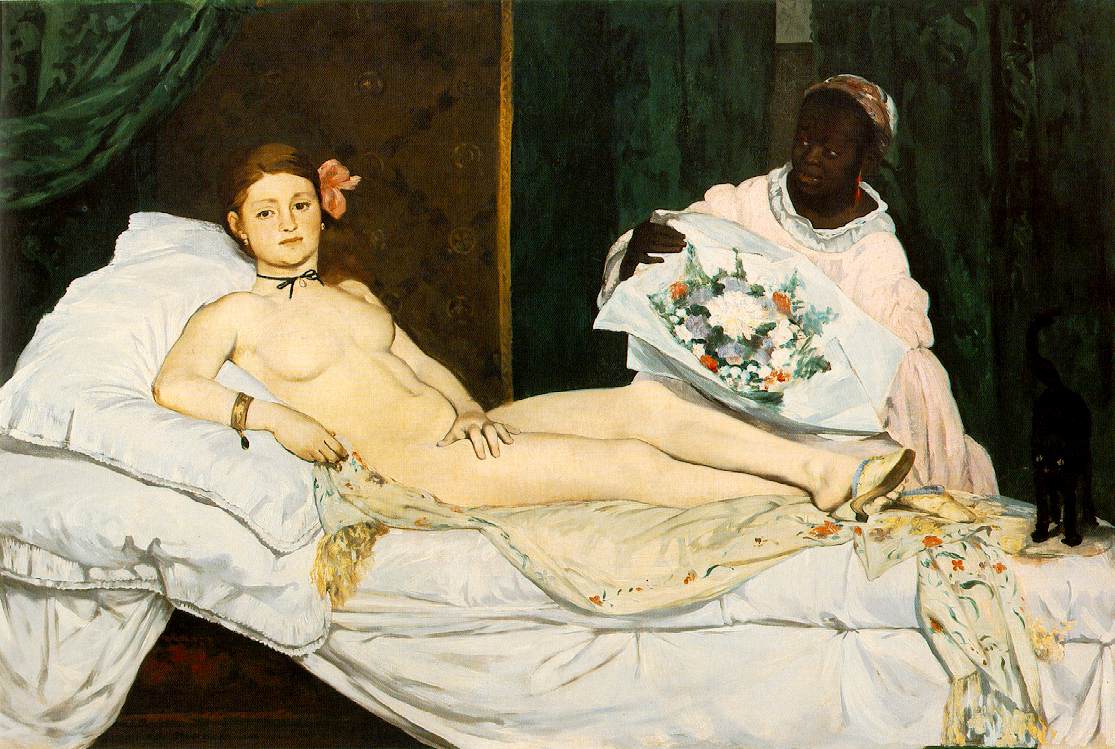
Manet's Olympia


"A perfume of delicious wickedness pervaded the atmosphere." Francis Schneider, Manet's biographer 

Manet's Olympia lies atop her unmade bed, reclining on over-sized pillows. Her black cat rests at her feet. Her black servant has brought in a fresh bouquet of flowers, a gift from a previous admirer. Olympia flaunts her nudity. She wears nothing in her Montmartre apartment, save for her slippers, a bracelet, a black ribbon around her neck and the symbolic orchid in her hair. She is no perfect woman, but she does glow in her confidence, dangerously bordering upon conceit. The flowers do not impress her, they only feed her dominant appetite. But then the door to this scene is opened unexpectedly, and there you stand. An early, intimate intruder. Take in the scene and the intimate scent that lingers above the fresh flowers, themselves both a trophy and a challenge. The black cat is alarmed. Olympia is not. She casts her gaze directly at you. She confronts and challenges you with her dark eyes. Well, this is what you came here for, isn't it? 


Scandal, shock and horror! Manet painted Olympia in 1863 and showed it in the Paris Salon of 1865. Surrounded by the acceptable nudes adorning the halls of Louvre. Olympia did not belong there! But where did this outrage eminate from? Certainly, the painted female nude was nothing new to the French bourgeouisie who attended the salons. However, everyone was used to the "academic" nude. Beautiful, idealized goddesses, who posessed two key virtues - perfection and modesty. But Olympia was no beautiful, idealized woman. She was real. And she was clearly a prostitute. Three strikes. 


Edouard Manet was born to aristocratic and political parents in 1832, and died of untreated syphlis in 1883. In between those 51 years, against his parents' wishes, he devoted himself to art. He is credited with being the link between Realism and Impressionism and for ushering in the dawn of modern art. In his twenties he travelled around Europe, studying and sketching the masterpieces he encountered. One such materpiece must have engrained itself deep into the psyche and sketchbooks of Manet - Titian's Venus of Urbino, which is hanging in the Uffizi in Florence. 


"Olympia" is a name that reminds us of mythology. Of Mount Olympus. Of gods and goddesses. It was most certainly acceptable to paint female nudes, so long as they were goddesses - coy and demure. Those adjectives describe Titian's Venus well. Her head tilts to the side and her eyes meet yours from her soft, reclining angle. Her left hand ever so delicately hides her vulva from view. Her skin tones are modeled to perfection. Her hair is the high Renaissance ideal.

"Olympia" is a name that reminded 19th century Paris of prostitution. It was a common name for these women at the time. Manet's Olympia is no goddess. She lays on her busy bed, receiving a floral gift from a prior client. And you are the next one, only you have arrived a bit too early. Olympia half-rises to meet your gaze directly with her challenging stare. Manet paints the orchid, another symbol of Parisian prostitution, in her hair. She is naked, save for a small black ribbon tied around her neck, a bracelet on her wrist, and one slipper dangling off of her feet. Her pose is directly descended from Titian's work. However, there are clear and bold breaks with the the Renaissance Olympia in Manet's work. The new Olympia is staring straight ahead, gone is the coy turning of the head to the side. The new Olympia is not a perfect woman. There seems to be an asymmetry of the eyes. Her skin is white. Too white. Manet has omitted the depth of modeling in the skin that Titian crafted. Manet's Olympia, too, holds her left hand over her vulva. However, she is not slightly hiding her genitals. She is forcefully defending them from your sight; a symbol of the new Olympia's sexual independence. 

Manet's painting does indeed manage to capture a distinct aroma of delicious wickedness. And sexuality. Those aromas are absent from the Titian painting, and all of the state-accepted academic art of the time. Manet, influenced of course by the masters, most successfully brings the classic woman out of the past and into the modern world. We have no goddesses here, Manet declares. Feast your eyes upon your new muse, gentlemen. She captivates in the ways those mythic nymphs never could.


Monday, December 10, 2012

Year End Music List Time. My 25 Most Favorite Tracks of the Year

25. "In A Big City" Titus Andronicus
 
24. "Paradise" Wild Nothing
 
23. "Six Pack" JEFF the Brotherhood
 
22. "Friends of Friends" Hospitality
 
21. "Watch The Corners" Dinosaur Jr.
 
20. "I Wonder Who She's Kissing Now" TV Girl
 
19. "Take A Walk" Passion Pit 

18. "So Long Marianne" Bill Callahan
 
17. "All Of Me" Tanlines

16. "Keep You" Wild Belle
 
15. "Pay in Blood" Bob Dylan
 
14. "Get Free" Major Lazer
 
13. "Become Someone Else's" Jens Lekman
 
12. "You As You Were" Shearwater
 
11. "Origins" Tennis

10. "Mr. Met" Lambchop
 
9. "Epic" Calexico
 
8. "Feels Like We Only Go Backwards" Tame Impala
 
7. "Open Your Heart" The Men
 
6. "That Old Black Hole" Dr. Dog
 
5. "1904" The Tallest Man On Earth
 
4. "Back From The Grave" Chromatics
 
3. "The House That Heaven Built" Japandroids
 
2. "Flutes" Hot Chip
 

1. "Stay Useless" The Cloud Nothings