Thursday, January 17, 2013

Manet's Olympia


"A perfume of delicious wickedness pervaded the atmosphere." Francis Schneider, Manet's biographer 
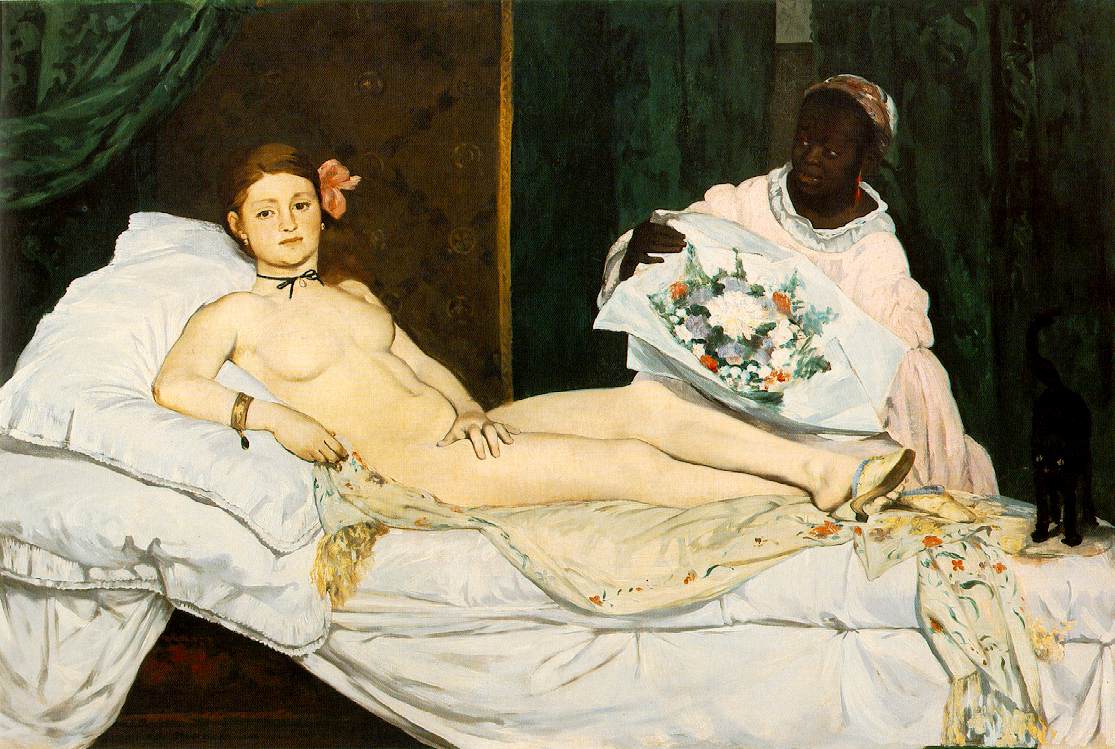
Manet's Olympia lies atop her unmade bed, reclining on over-sized pillows. Her black cat rests at her feet. Her black servant has brought in a fresh bouquet of flowers, a gift from a previous admirer. Olympia flaunts her nudity. She wears nothing in her Montmartre apartment, save for her slippers, a bracelet, a black ribbon around her neck and the symbolic orchid in her hair. She is no perfect woman, but she does glow in her confidence, dangerously bordering upon conceit. The flowers do not impress her, they only feed her dominant appetite. But then the door to this scene is opened unexpectedly, and there you stand. An early, intimate intruder. Take in the scene and the intimate scent that lingers above the fresh flowers, themselves both a trophy and a challenge. The black cat is alarmed. Olympia is not. She casts her gaze directly at you. She confronts and challenges you with her dark eyes. Well, this is what you came here for, isn't it? 


Scandal, shock and horror! Manet painted Olympia in 1863 and showed it in the Paris Salon of 1865. Surrounded by the acceptable nudes adorning the halls of Louvre. Olympia did not belong there! But where did this outrage eminate from? Certainly, the painted female nude was nothing new to the French bourgeouisie who attended the salons. However, everyone was used to the "academic" nude. Beautiful, idealized goddesses, who posessed two key virtues - perfection and modesty. But Olympia was no beautiful, idealized woman. She was real. And she was clearly a prostitute. Three strikes. 


Edouard Manet was born to aristocratic and political parents in 1832, and died of untreated syphlis in 1883. In between those 51 years, against his parents' wishes, he devoted himself to art. He is credited with being the link between Realism and Impressionism and for ushering in the dawn of modern art. In his twenties he travelled around Europe, studying and sketching the masterpieces he encountered. One such materpiece must have engrained itself deep into the psyche and sketchbooks of Manet - Titian's Venus of Urbino, which is hanging in the Uffizi in Florence. 


"Olympia" is a name that reminds us of mythology. Of Mount Olympus. Of gods and goddesses. It was most certainly acceptable to paint female nudes, so long as they were goddesses - coy and demure. Those adjectives describe Titian's Venus well. Her head tilts to the side and her eyes meet yours from her soft, reclining angle. Her left hand ever so delicately hides her vulva from view. Her skin tones are modeled to perfection. Her hair is the high Renaissance ideal.

"Olympia" is a name that reminded 19th century Paris of prostitution. It was a common name for these women at the time. Manet's Olympia is no goddess. She lays on her busy bed, receiving a floral gift from a prior client. And you are the next one, only you have arrived a bit too early. Olympia half-rises to meet your gaze directly with her challenging stare. Manet paints the orchid, another symbol of Parisian prostitution, in her hair. She is naked, save for a small black ribbon tied around her neck, a bracelet on her wrist, and one slipper dangling off of her feet. Her pose is directly descended from Titian's work. However, there are clear and bold breaks with the the Renaissance Olympia in Manet's work. The new Olympia is staring straight ahead, gone is the coy turning of the head to the side. The new Olympia is not a perfect woman. There seems to be an asymmetry of the eyes. Her skin is white. Too white. Manet has omitted the depth of modeling in the skin that Titian crafted. Manet's Olympia, too, holds her left hand over her vulva. However, she is not slightly hiding her genitals. She is forcefully defending them from your sight; a symbol of the new Olympia's sexual independence. 

Manet's painting does indeed manage to capture a distinct aroma of delicious wickedness. And sexuality. Those aromas are absent from the Titian painting, and all of the state-accepted academic art of the time. Manet, influenced of course by the masters, most successfully brings the classic woman out of the past and into the modern world. We have no goddesses here, Manet declares. Feast your eyes upon your new muse, gentlemen. She captivates in the ways those mythic nymphs never could.


Monday, December 10, 2012

Year End Music List Time. My 25 Most Favorite Tracks of the Year

25. "In A Big City" Titus Andronicus
 
24. "Paradise" Wild Nothing
 
23. "Six Pack" JEFF the Brotherhood
 
22. "Friends of Friends" Hospitality
 
21. "Watch The Corners" Dinosaur Jr.
 
20. "I Wonder Who She's Kissing Now" TV Girl
 
19. "Take A Walk" Passion Pit 

18. "So Long Marianne" Bill Callahan
 
17. "All Of Me" Tanlines

16. "Keep You" Wild Belle
 
15. "Pay in Blood" Bob Dylan
 
14. "Get Free" Major Lazer
 
13. "Become Someone Else's" Jens Lekman
 
12. "You As You Were" Shearwater
 
11. "Origins" Tennis

10. "Mr. Met" Lambchop
 
9. "Epic" Calexico
 
8. "Feels Like We Only Go Backwards" Tame Impala
 
7. "Open Your Heart" The Men
 
6. "That Old Black Hole" Dr. Dog
 
5. "1904" The Tallest Man On Earth
 
4. "Back From The Grave" Chromatics
 
3. "The House That Heaven Built" Japandroids
 
2. "Flutes" Hot Chip
 

1. "Stay Useless" The Cloud Nothings
 

Year End Music List Time. 2012, My Ten Favorite Albums of the Year

10. Algiers, Calexico
  A Calexico album is always good. I miss the more cinematic, sweeping, Cormac McCarthy-esque instrumentals of their first albums, but Algiers is solid. It is pristine and beautiful in its orchestration and production. Definitely my favorite Calexico record since Feast of Wire.


9. Mr. M, Lambchop
 Just like Calexico, I will always have spot in my heart and in my year-end list for a Lambchop release. Kurt's voice has somehow softened even more than his usual breathy delivery (a Lambchop hallmark). There is a vunerability to each line that glows along with the delicate orchestration that sways with each song.


8. There's No Leaving Now, The Tallest Man on Earth
 There seems to be a theme developing here. Another album that shines from the delicacy and tenderness it displays. This album deserves multiple plays. Easily this Swedish songwriter's best album.


7. In Our Heads, Hot Chip
 Hot Chip is in full house-dance-mode here. These songs are densely electronic and processed. But in a good way.


6. Lonerism, Tame Impala
 I admit it. At first, I was not slurping the Pitchfork Kool-Aid on this album. I listened to the first single "Elephant." Blah blah, meh. But later I heard the sublime "Feels Like We Only Go Backwards." Then I rushed out to hear this record, and I'm glad I did. "Elephant" is still weak though. Hipster stuff...


5. Tempest, Bob Dylan
 Bob Dylan is on a roll. He has made nothing but wonderful albums ever since Time Out of Mind. Subtract the last two songs from this album and it might have ranked even higher.


4. I Know What Love Isn't, Jens Lekman
 Upon first listen, I admit I did miss the quirky samples Jens would spice his songs with. But on second and third and fourth listens, I am definitely attracted to the charming songwriting, arrangements and sentiments here.


3. Kill For Love, The Chromatics
 Listen to this album and write. Listen to this album and paint. Listen to this album and make out. Listen to this album.


2. Celebration Rock, Japandroids
 This album is everything that indie rock is supposed to be. Retreat away from the computer rock that has been dominating the indie scene the past three years. Travel back to the days when the kids were influenced by Husker-Du. This album rocks.


1. Attack on Memory, Cloud Nothings
 Steve Albini produces masterpieces. This album ran the table for me in 2012. It was my favorite album the first time I listened to it. I'm sad to see that it hasn't been getting much love lately. They're overlooking you, Dylan Baldi.

Year End Music List Time. 2012, My Favorite Album Cover

"Mr. M" by Lambchop

Painting by frontman Kurt Wagner as an album cover? Yes, thank you. Like most Lambchop releases, Mr. M boasts a beautiful layout. This one features a small collection of this Wagner motif.

Tuesday, November 13, 2012

Put the Book Back On The Shelf


Charles Bukowski was a real asshole. Or at least that is the impression I get when I read his angry writing, gritty songs from the sewer. His voice always on the outside of society and mired in a drunken misery. A poem of his has stood out to me for sometime now, flashing in and out of my consciousness. It has the quintessential Bukowski title – “To the Whore Who Took My Poems” and the quintessential Bukowski scenario – a prostitute has made off with twelve of his poems (and his best paintings!) leaving him to plead, alone (and drunk I presume), to cry out, desperate and defeated, “Are you trying to crush me out like the rest of them?”
No girl ever stole my poems. Or my paintings. I could hardly even give any of those away. Sometimes when I did, they ended up coming back. I don’t even really want them anymore, but what am I supposed to do, throw them away?
No girl ever stole any of my books either. I just always lent them out, and they never ended up coming back. I won’t cry alone about them like Bukowski in defeat. I don’t look at the vacancies on my bookshelf as all-powerful cosmic forces that are leveling themselves against me, as I imagine Chuck felt. Instead, whenever I think of the Bukowski poem, I ponder about each of my missing books, where they might have ended up, and that every girl I ever dated and lent a book to, disappeared from my life. Just like the books.
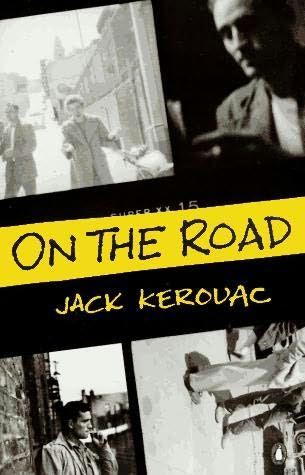
First off, I lent Summer my copy of On the Road. I was deep in my wild Kerouac phase, back then all of seventeen years old with “nothing to offer to anyone but my own confusion[1],” and a copy of On the Road. She seemed to love it as much as I did. We would go to our town’s only all-night diner and order coffee and apple pies and talk late into the suburban night about those wild beat characters, both of us envious of the maddening freedom painted in words on each page. Eventually, we sought out other company and more exciting things than apple pie and talking about Dean Moriarity and Sal Paradise. And I never got my On the Road back.
    Nikki said she wanted to read a book. It seemed like this might have been something novel for her. I didn’t want to overwhelm her so I lent her something easy to digest but was also one of my all-time favorites, Skipped Parts, by Tim Sandlin. Anyone would love Sandlin’s straightforward story-telling and laugh-out-loud humor. Nikki said she didn’t get it. I think she lent it to a friend. I never saw that copy again.
  I lent The Picture of Dorian Grey to some girl in a college class of mine to try to impress her. It didn’t work. And I can’t remember her name or why I never got my book back.
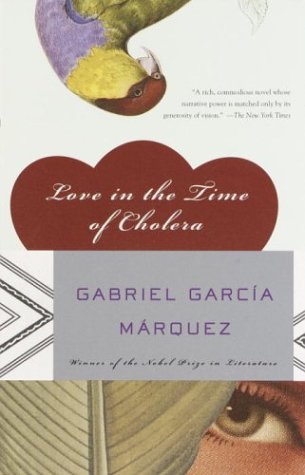
Heather wanted to borrow Love in the Time of Cholera, and I was pleased to lend it out. In some strange sense of the symmetry of life, I had read this book because another girl had suggested it a few years before. Or maybe there’s actually no symmetry there at all. Not long after Heather finished the book, we were finished too.
Lauren asked me what my favorite book of all-time was. I told her One Hundred Years of Solitude. She asked to borrow it. I knew as soon as I handed it to her that I was never going to see that book again.
The last book I ever lent to a girl I was dating was to Kimberly. She wanted something to read and so I recommended Highwire Moon, by Susan Straight. Kimberly loved the book and the way Straight could weave beautiful scenes together with words. She ended up taking the book with her on a trip for work to San Francisco. Kimberly called me from Frisco, upset, and said that she left the book in the backseat of a cab. I told her not to worry about it. She ordered another hardcover copy of Highwire Moon for me, and later became my wife.


[1] Gratuitous Kerouac quote, from On the Road

Monday, October 29, 2012

Them's It's All Over Now, Baby Blue

There are songs that swell up inside of me with their simple graceful beauty and melodious majesty and I listen and I listen and when it reaches their brilliant conclusion, I'm left to declare, I must write about this song. 

Such is the case with Them's gorgeous version of Dylan's "It's All Over Now, Baby Blue."

I was a junior in high school, 1996, the first time I heard the ringing interplay of organ and guitar notes that form the hallmark of this version of the classic Dylan song. Only, it wasn't Them I was listening to. It was a song by Beck. Jackass, off of his seminal album, Odelay (possibly one of the greatest albums of the 1990s). I became instantly infatuated with this sound. A sample, I learned from investigating the tiny congested liner notes inside of Odelay. It read something to point that Jackass contained a sample from "It's All Over Now, Baby Blue," by Bob Dylan. I did not yet know of this Dylan song. I was not the Dylanphile I am now. But the sample, used so prominently and effectively throughout "Jackass" sent me to the record store to buy Dylan's Bringing It All Back Home. I had to hear his original. I had to hear this sample in its natural form.

I arrived at the album's ultimate song, track 11, "It's All Over Now, Baby Blue" but there were no organ notes, no delicately plucked electric guitar. It was sparse, classic acoustic Dylan (I would fully realize a few year's later)with his perfect annunciation of each devastatingly beautiful line like, "Yonder stands your orphan with his gun/Crying like a fire in the sun," which all lead to his somber, repeated, declaration - that it is indeed all over now, Baby Blue. As heavenly as the original is, is it blasphemous to say that I like the cover more?* I mean, just listen to the Them version. The aforementioned organ, the guitar, the waltzing bass line, and the power of Van Morrison's voice, the way he plays those vocal chords like Coltrane played the tenor sax. He's got a vocal range that frolics from raspy desperation to howling back to tender resignation.

No. I did not find the delicious sample from "Jackass" on the Dylan original. I was left to wonder, back in those days before every answer was just a Google search away, where did this sample come from?!

Years later, much after I had forgotten about this silly quest, I was watching Julian Schnabel's biopic of Basquiat. In a scene with the actor-version Basquita and his girlfriend, played by one of all-time favorite actress crushes, Claire Forlani, are in her apartment painting, THERE IT WAS!. The organ and guitar sample I had been waiting to discover. In its original version.

White Whale! Dr. Livingston, I have found you!


*On a similar note, could anyone say that Dylan's "All Along the Watchtower is superior to the Jimi Hendrix Experience's cover? Nay.

Monday, September 17, 2012

The Times They Are A-Changin'

"Come gather 'round people wherever you roam..."

Dylan welcomed the world into his song with the ancient archetypical greeting laid down by minstrels and folksters and voices of protest that had echoed down the wind for years and years.

The anthem begins. If there ever was a song to capture the moment of the early 1960s, it would be this song. Dylan's "The Times They Are-A Changin'" is a song that can both fit perfect into a spot, say 1964, and then transcend beyond that spot so that when some teenager in 1998 stumbles across it, it still sounds present.

It's the opening track for Dylan's third album, also called The Times They Are-A Changin'. Released in January of 1964, this collection would be the both the climax and the conclusion of his protest song period. His next albums would find him experimenting with ever-encrytping personal symbolist poetry, and soon sonically with electric instruments (with infamous and world shattering results). This is the last album where Dylan would wear they storyteller of society hat. His last Woody Guthrie pose. By 1963, Dylan was the undisputed king of protest music. One mask he would soon tear off and set into the fire.

Come gather 'round... The storyteller has a message for you. One last time. Admit that things are changing, and that you should change too. An anthem call to get on board the train of change or else by left behind in its coal-burning dust.

But I'm no child of the 1960s. I came of age in the 1990s. I cannot relate to those who staged sit-ins amidst the fists and spit of centuries of hatred. I can try and protest, but I usually stay home instead and read. or listen to Dylan. For me, as with anyone with memories of being a rebellious teenager, I can still relate to one specific golden line aimed at parents, "Don't criticize what you can't understand, your sons and daughters are beyond your command, your old road is rapidly aging..."

Why does this song still grab me? I am a history teacher. It might be the history teacher in me that has always been drawn to this song. I see with ease the context this song sits in. The Civil Rights movement. The bifrth of the anti-war movement. The free speech college protests. The transformational years before 1968 exploded.

Is this song about the inevitability of change happening on it sown, or is it an invitation to ride a wave and join the movement? To affect change?

When did Dylan record it? October 1963. One month later, John F. Kennedy would be assassinated in Texas. What does that do to the dreamer? To the agent of change. Dylan would say that "they are trying to tell you Don't even hope to change things."

Could JFK's assassination have killed the change agent in Dylan? Could it be what pushed Dylan out of protest and into poetry? Something I've been wondering lately...